
When computers give up, the spectrometer learns for itself
NMR can reveal how molecules and materials are built down to the atomic level. But when only tiny amounts of material are available, the signal quickly becomes too weak. A well-established technique can boost the sensitivity dramatically – but in complex spin systems, finding the right microwave pulses becomes a calculation problem beyond even the most powerful computers. Researchers at Aarhus University have taken a different route: they let the spectrometer learn directly from the real sample.

Imagine trying to shepherd a large group of sugar-fuelled children through an amusement park.
You cannot plan in advance exactly which combination of words, tone of voice, timing and body language will keep everyone moving in the right direction. Different rides tempt different children, the children influence one another, and the larger the group, the harder it becomes to predict what will work.
At some point, the best strategy is to try something, see what happens and adjust as you go.
With no other connection whatsoever, researchers at Aarhus University have adopted much the same strategy for a very different problem: controlling a large quantum-mechanical network of atomic nuclei and electrons.
An atomic detective tool
Spin is a quantum property that makes atomic nuclei and electrons behave somewhat like tiny magnets. Nuclear spin is the physical basis of both NMR spectroscopy and MRI.
In an NMR experiment, a sample is placed in a powerful magnetic field and exposed to a short radio-frequency pulse. The nuclei respond with faint radio signals whose frequencies depend on their local chemical surroundings.
That makes NMR a kind of atomic detective tool.
It can do more than identify which substances are present in a sample. The signals can reveal which atoms sit next to one another, how a molecule is folded and how it moves.
But NMR has an Achilles’ heel: sensitivity.
“NMR has the same disadvantage as MRI scanners: it is relatively insensitive. The samples need to contain a high concentration of the molecules or materials you want to analyse,” says Professor Niels Chr. Nielsen from the Department of Chemistry at Aarhus University.
The reason is that only a tiny excess of nuclear spins point in one direction rather than the other in the magnetic field. Most of their magnetic contributions therefore cancel each other out, leaving only a weak overall NMR signal.
If researchers could persuade more of the nuclear spins to line up the same way, the signal would become much stronger.
This is where electrons come in.
Let the electrons bring some order
An electron’s magnetic moment is about 660 times larger than that of a proton. At low temperatures and in a strong magnetic field, electron spins can therefore become much more strongly polarised than nuclear spins.
Using carefully designed microwave pulses, researchers can transfer some of that order from the electron spins to the nuclear spins.
In a sense, the electrons rub off on the nuclei.
The technique is known as dynamic nuclear polarisation, or DNP, and in suitable systems it can boost NMR sensitivity by hundreds or even thousands of times, depending on the nucleus involved.
That can make otherwise invisible samples or structures accessible to NMR.
But there is a catch.
The electrons are both the solution and the problem
The microwave pulses cannot simply be fired into the sample at random. Their strength, phase, duration and sequence must be carefully designed to control the spin system in the right way.
And this is where the problem explodes.
A single electron may interact with hundreds or thousands of surrounding atomic nuclei. If the spin system is small, researchers can model how the particles behave and calculate suitable pulse sequences.
But once the system grows to hundreds or thousands of spins, exact calculations quickly become unrealistic. Even the largest computers can no longer keep up.
And a computer model has another weakness: it does not necessarily know about every imperfection in the real instrument.
So why build a perfect model of reality when reality itself is already sitting in the laboratory?
Reality instead of simulation
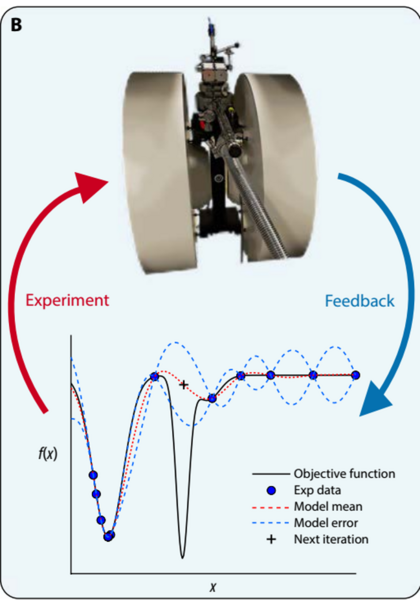
The Aarhus researchers connected an advanced DNP spectrometer to a Bayesian optimisation algorithm – a form of machine learning.
The system tests a pulse sequence directly on the physical sample, measures the outcome and feeds the result back to the algorithm.
If the sequence worked well, the algorithm learns from it. If it worked poorly, it learns from that too.
It then proposes the next experiment.
The process continues until the spectrometer has learned its way towards an effective measurement strategy.
“What is new is that we let the spectrometer itself learn how to perform the best experiments. We do this using AI,” says PhD student Filip V. Jensen, first author of the study, published in Science Advances.
The researchers tested the method on two different spin systems. In the simpler system, the algorithm found solutions comparable with some of the best existing approaches.
In the more complex system, the pulse sequence found by the algorithm produced around 70 per cent greater signal enhancement than the method used as a reference.
Fundamental research with wider ambitions
Niels Chr. Nielsen stresses that the work is still fundamental research.
But he also sees considerable potential beyond the immediate DNP experiment.
“We are trying to move an established technology such as magnetic resonance, which includes NMR and MRI, into a new regime of very low concentrations. And that could bring major benefits,” he says.
Greater sensitivity also reduces measurement time. If the sensitivity is increased, fewer repetitions are needed to obtain a useful signal.
“If, for example, we one day succeed in increasing the sensitivity by a factor of 1,000, we reduce the measurement time by a factor of 1,000² – which is one million,” says Nielsen.
He also sees the method as a possible tool for developing magnetic-resonance-based quantum sensors.
“There are very high expectations in society for quantum sensors in general, and very high expectations for magnetic-resonance-based quantum sensors,” he says.
Because the new approach does not require researchers to simulate every detail of a large spin system in advance, it could help in the development of sensors that extract useful information from increasingly complex systems.
In the longer term, Nielsen sees possible applications in advanced laboratories and areas such as industrial process monitoring, environmental measurements and food analysis.
Sensitivity is not the whole story
Other analytical methods can be far more sensitive than NMR if the only task is to detect whether a tiny amount of a particular substance is present.
But NMR offers something different.
It can reveal how molecules and materials are built and what is happening in their immediate surroundings.
Niels Chr. Nielsen explains the distinction with an example that is close to hand – or rather, slightly higher up:
“If you put my head into an optical sensor, you would probably mostly learn that I do not have much hair. But if you put my head into an MRI scanner, you have a chance of seeing what is inside.”
FACT BOX: What is NMR used for?
An NMR spectrometer can do more than identify which substances are present in a sample. Signals from atomic nuclei can also reveal which atoms are next to one another, how a molecule is folded and how it moves.
A chemist can use NMR to determine the structure of a new molecule. A protein researcher can investigate how a protein changes shape when it binds to another molecule. A materials scientist can study the chemical environment around the active sites of a catalyst – the places where the chemical reaction actually takes place.
NMR is therefore used both in fundamental research and outside universities, including in the pharmaceutical and chemical industries and in food analysis.
If the sensitivity problem can be pushed much further, those applications could expand considerably. That is part of the broader vision for magnetic-resonance-based quantum sensors.
Additional information | |
| We strive to ensure that all our articles live up to the Danish universities' principles for good research communication(scroll down to find the English version on the web-site). Because of this the article will be supplemented with the following information: | |
| Funding | The Villum Foundation, The Novo Nordisk Foundation, The Carlsberg Foundation |
| Collaborators | Danish e-Infrastructure Cooperation (DeiC) supercomputer |
| Read more | The scientific article In situ learning-based spin engineering of pulsed dynamic nuclear polarization in Science Advances |
| Contact | Professor Niels Chr. Nielsen, Ph.d.-student Filip V. Jensen
|