
Sustainable energy technologies are critical to the green transition, yet many rely on scarce materials. A key question arises as we look to power the future: How can we create sustainable energy materials without depleting our planet's resources? To achieve this, we must discover new energy materials made from abundant, sustainable resources. However, this is a complex scientific challenge, as even small changes in the composition of these materials can have a considerable impact on their ability to convert energy efficiently.
Energy materials are typically crystalline, and while most research has focused on the average arrangement of atoms in these crystals, we now know that the important properties often come from small, local variations within these structures. These subtle deviations, or disorder, play a critical role in energy conversion. However, they have been largely overlooked in traditional research, creating a significant gap in our understanding of how materials convert and store energy.
At the Center for Sustainable Energy Materials, we are working to close this gap by understanding and learning to control structural disorder in crystalline materials. By carefully managing these variations, we can unlock new ways to enhance the materials’ energy conversion properties. Thanks to recent breakthroughs in structural analysis, we now have the tools to study these materials in unprecedented detail. By bringing together experts in energy materials, chemical synthesis, scattering techniques, electron microscopy, nuclear magnetic resonance (NMR), theoretical modelling and property characterization, we are pioneering new pathways for more efficient and sustainable energy materials.
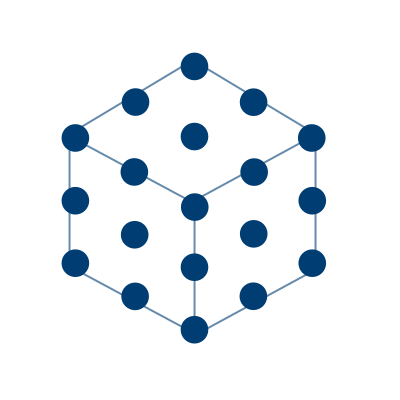
The way atoms are positioned relative to each other dictates the properties of the material. To illustrate material structures, atoms are typically depicted as spheres.

Energy materials drive conversion and storage of renewable energy. To power the future, we need new, sustainable energy materials based on abundant raw materials.
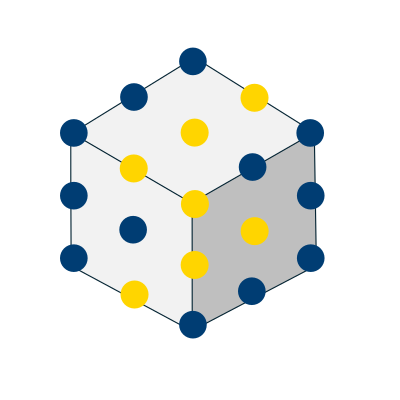
Atomic structures often entail local disorder as deviations from the average long-range scale order. Learning to control disorder is the key to unlocking novel sustainable energy materials.

Crystallography has a blind side: It assumes that all materials are perfect crystals, but often they are not. This causes problems, considering that desired material properties often originate from local deviations from the perfect crystalline structure, i.e. disorder in a crystalline material. The key point is that disorder is often far from random – it is governed by local chemistry, atomic interactions, and bonding preferences. We explore how structural disorder influences a material’s function by applying various advanced techniques for structural and property characterization.
At CENSEMAT, we investigate the nature of structural disorder in energy materials and correlate it to the properties responsible for energy conversion, such as ion, electron and heat transport.
Powder X-ray diffraction (PXRD) / Pair Distribution Function (PDF) / Nuclear Magnetic Resonance (NMR) / Transmission Electron Microscopy (TEM)
Chemical synthesis is fundamental to material design. Combining our expertise in this craft with insights from advanced structural analysis, we move beyond trial-and-error methods, leveraging simulation-guided approaches to identify abundant alternative materials and optimize synthesis techniques.
At CENSEMAT, we synthesize novel materials based on structural analysis and simulations, accelerating the discovery of sustainable energy materials.
Machine-Learned Force Fields / Monte Carlo simulations / In-situ / Diffraction / Pair Distribution Function / Transmission Electron Microscopy / Nuclear Magnetic Resonance


Energy conversion processes are inherently dynamic, often causing local deviations from global structural order. These fluctuations in disorder can significantly impact material properties and performance over time. Through operando studies, we analyze structural changes occurring in real-time during energy conversion. This enables us to identify more efficient, stable, and durable materials for long-term energy applications.
At CENSEMAT, we aim to uncover the mechanisms behind energy conversion and their impact on structural disorder.
Operando 1D-PDF studies / 4D-STEM / STEM-EDX / ex-situ NMR / PXRD / 3D-ΔPDF
