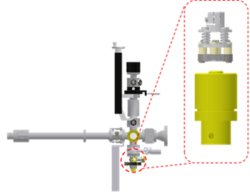
We have developed a versatile eletrochemical cell that allows us to measure most relevant electrochemical properties and stability of surface science model systems. We investigate both single crystals surfaces (such as Cu and Ni), and supported systems such as oxide nanoparticles on these supports. The cell enables STM and XPS characterization before and after electrochemical measurements, and is currently used to investigate electrocatalysts for the oxygen evolution reaction (OER), oxygen reduction (ORR) and CO2 reduction (CO2RR).
The construction was funded by Carlsbergfondet (2018-2021)
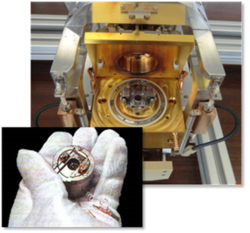
We invesitgate surface science model catalysts in operando conditions using ambient pressure scanning tunneling microscopy (AP-STM) and x-ray photoemission spectroscopy (AP-PES). The SPECS Aarhus STM allows us to image surfaces in controlled atmospheres at at elevated temperature, i.e. under conditions that are approaching the real catalytic conditions. AP-XPS is carried out at synchtrons, such as MAX-IV, Lund, Sweden.
The project is funded by a Villumfonden Research Project (#13264)
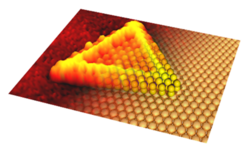
In the project we study the fundamental properties of metal-sulfide nanocatalyst using the Scanning Tunneling Microscope (STM). The hydrotreating catalyst based on MoS2 is among the most important heterogeneous catalysts used today, since it is used for upgrading crude oil. More importantly, the same catalyst are also important for the transition to renewable energy, since the same catalyst types can be used for upgrading of various types of bio-oils Using the STM, we can successfully use the STM to provide a genuine atomic-scale view of the active MoS2 nanoclusters and follow in atomic detail the key intermediate steps in the desulfurization process, and based on this insight we collaborate with an industry partner to develop new hydrotreating catalyst. We participate in the HyProFuel project (Innovation Fund Denmark, 2022-2026), that specifically aims to develop catalysts for production of fuels from bio-waste.
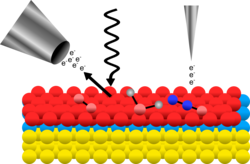
Thermal decomposition of N2O to N2 and O2 is a crucial reaction to reduce the environmental impact of N2O. Co3O4 is one of the most active catalysts for low-temperature decomposition of N2O. In this project we study the decomposition of N2O on cobalt oxide model systems using x-ray photoemission spectroscopy (XPS) and scanning-tunneling microscopy (STM). Using XPS, we can track the chemical composition of cobalt oxide and surface intermediates under reaction conditions, which provides crucial insight into the reaction mechanism of N2O decomposition on cobalt oxide. Additionally, STM provides atomic scale resolution of structural changes occurring on the cobalt oxide surface. Overall, the combination of XPS and STM gives us the ability to obtain both chemical and structural information about the N2O decomposition pathways.
