
Three researchers involved in new DFF-funded projects
Three researchers from the Department of Chemistry at Aarhus University are involved in re-search projects funded by Independent Research Fund Denmark (DFF). The projects cover a broad range of research areas, from molecular detection and DNA structures to environmen-tal sustainability.
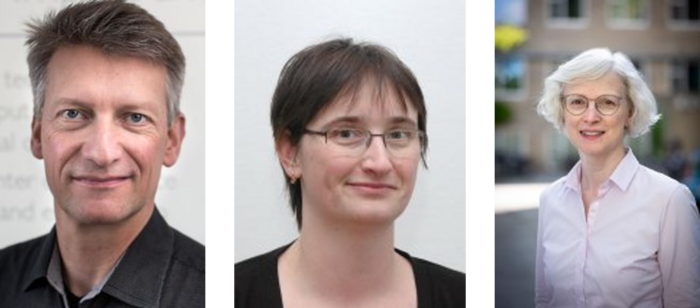
The two grant recipients, Kurt Vesterager Gothelf and Victoria Birkedal, have each received DKK 3.66 million through the DFF Research Project 1 programme. In addition, Marianne Glasius is a co-applicant on a DKK 7.2 million project led by Professor Tenna Riis from the Department of Biology, investigating how the rewetting of agricultural land affects nearby streams.
Read more about the projects here:
Phosphodiester-based oligomers for new classes of luminescent foldamers
Professor Kurt Vesterager Gothelf has received DKK 3.66 million to develop a new class of artificial luminescent lanthanide complexes that could enable more sensitive detection of biological molecules using time-resolved Förster resonance energy transfer (TR-FRET). Conventional fluorescence-based detection methods can be limited by background signals arising from autofluorescence in biological samples.
Using synthetic methods developed for DNA synthesis, the project will create artificial oligomers that fold into well-defined three-dimensional structures and precisely organise ligands coordinating luminescent lanthanide ions. By controlling the molecular architecture, the researchers aim to enhance the luminescence properties of these complexes and establish new principles for designing light-emitting molecular materials. In the longer term, the technology could contribute to the development of more sensitive biosensors and diagnostic methods for detecting disease biomarkers.
Impact of biomolecular dynamics on regulatory roles of G-rich nucleic acids structures
Associate Professor Victoria Birkedal has received DKK 3.66 million to investigate how the structure and dynamics of a class of nucleic acid structures influence their biological functions. Although DNA is best known for its double helical form, nucleic acids can also fold into more intricate structures that play important roles in regulating cellular processes, with implications for health and disease.
The project will employ advanced experimental methods that combine high-throughput sequencing with single-molecule fluorescence microscopy, enabling the simultaneous observation of thousands of individual nucleic acid molecules in real time. By studying how sequences, structures, and dynamics are connected, the researchers aim to provide a mechanistic understanding of the molecular rules involved in biological regulation.
Sustainable rewetting of agricultural riparian areas: Understanding mechanistic links between dissolved organic matter compounds and stream ecosystem consequences
Professor Marianne Glasius is a co-applicant on a DKK 7.2 million project led by Professor Tenna Riis that will investigate how rewetting former agricultural land affects nearby streams. Wetland restoration is an important tool for reducing greenhouse gas emissions, but it can also release organic compounds into surrounding waterways, potentially reducing oxygen levels and water clarity.
The project brings together stream ecologists and analytical chemists to identify which compounds are responsible for these effects. Using advanced mass spectrometry, the researchers will analyse thousands of organic molecules released from rewetted soils and investigate how they influence aquatic ecosystems. The findings could help ensure that wetland restoration contributes to climate mitigation without negatively affecting freshwater environments.
The Department of Chemistry congratulates Kurt Vesterager Gothelf, Victoria Birkedal and Marianne Glasius on the grants.